The Day You Became A Better Writer
In 2007, Scott Adams — creator of Dilbert — published a short blog post on writing. Naval Ravikant thought it was worth adding to his recommended reading list in the Almanack of Naval Ravikant.
There's one problem. Typepad, the blogging platform that hosted it, shut down permanently on September 30, 2025. The post disappeared with it.
I tracked it down through the Internet Archive. You can read the original here.
This post is my attempt to make it accessible — and to add something new.
What Adams said
Adams opens with a claim: he went from bad writer to good writer after a single one-day course in business writing. Then he gives you the whole course in under 200 words.
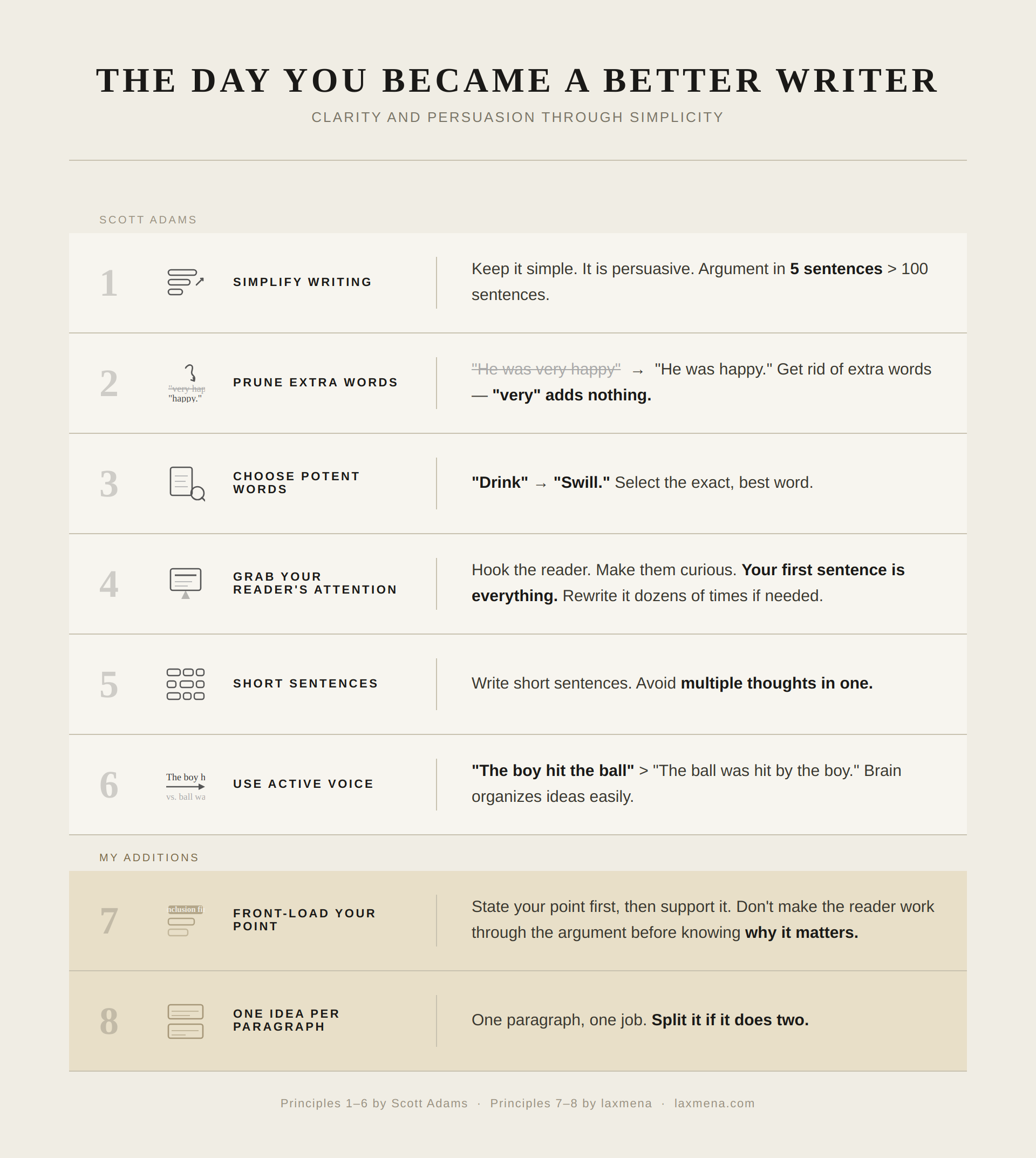
The core idea is simple. Simple writing is persuasive. A tight five-sentence argument beats a sprawling hundred-sentence one. Every time.
Here are his rules, distilled:
My additions
Adams covers the sentence level well. These extend his thinking to structure.
7. Front-load your point. State the conclusion first, then support it. Don't make the reader work through the argument before knowing why it matters.
8. One idea per paragraph. Adams says one thought per sentence. The same logic applies one level up. If a paragraph is doing two jobs, split it.
Steal this prompt
If you use LLMs to help draft or edit writing, here's a prompt you can drop into your workflow. It distills everything above into instructions the model will actually follow.
You are a writing assistant that helps produce clear, persuasive, and readable text.

Follow these principles when writing or editing:

- Keep it simple. A short, clear argument is more persuasive than a long, complex one.
- Cut extra words. If a word doesn't add meaning, remove it.
- Choose potent words. Prefer the specific and vivid over the generic.
- Make the first sentence earn attention. It should create curiosity or make a bold claim.
- Write short sentences. One thought per sentence.
- Use active voice. Put the actor before the action.
- Front-load the point. State the conclusion first, then support it.
- One idea per paragraph. If a paragraph is doing two jobs, split it.

When editing, flag sentences that violate these rules and suggest alternatives.
Good writing is good thinking made visible. Adams knew this in 2007. It hasn't changed.
All original ideas referenced here belong to Scott Adams. This post exists to preserve and extend his thinking, not to replace it. Read the [original](https://web.archive.org/web/20240302003157/https://dilbertblog.typepad.com/thedilbertblog/2007/06/thedayyoubec.html)._