Of 214 community skills audited last year, nearly three-quarters scored below 60 out of 100. The failures were mostly invisible: no crash, no error message, just a skill that ran, returned something plausible, and skipped the step that mattered. That gap is the problem I want to work on.
My book club is reading Abundance by Ezra Klein and Derek Thompson this month. The core idea fits on a napkin, so before the meeting I decided to actually check it against real data. Here's what I found, and where it fell apart.
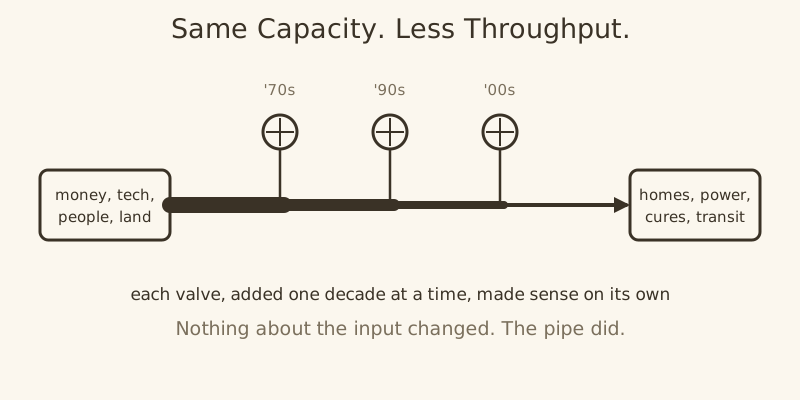
The idea, in one picture
Housing, clean energy, cures for disease. The inputs to all three haven't really moved. Money's there. Technology got cheaper, not more expensive. Roughly the same number of people know how to build this stuff as always did.
What changed is the pipe between the inputs and the output.
Over the decades, every time something went wrong, somebody added a valve. A highway almost bulldozed a neighborhood in the '70s, so now there's a checkpoint for that. An environmental study got added in the '90s. By the 2000s you needed a public comment period too, sometimes more than one. None of these were dumb decisions in isolation. Each solved something real. But stack enough of them and the pipe might as well be shut, even though nothing on the input side changed at all.
Klein and Thompson call this chosen scarcity. Anyone who's inherited a legacy codebase already knows the pattern under a different name: unaddressed technical debt. A pile of individually-reasonable shortcuts, left unrefactored for so long that the system's throughput has almost nothing to do with its actual capacity anymore.
I liked the idea. I also didn't fully trust it. So before the meeting, I ran the numbers.
Every platform that optimizes for engagement will be gamed. That's not a cynical take – it's an incentive problem. When the metric is clicks, shares, and reactions, the system rewards content that triggers emotion, not content that builds understanding. In AI right now, that means 90% of what you see is noise dressed up as signal.
Bell Labs invented the transistor, the laser, and information theory. They also invented a way of thinking. Here are nine mental models from The Idea Factory by Jon Gertner.
When I split focus across tasks, I produce incomplete, low-quality output. Single-tasking changed that. I do deeper work, and I do more of it — no context-switching tax.
1,000,000,000 rows of data. No hand-tuning. Just an agent, a benchmark, and a budget.
The 1 Billion Row Challenge is simple on paper: read a file with 1B rows of weather station measurements, compute min/mean/max per station, as fast as possible. In Python, a naive solution takes minutes. The best human-optimized ones use memory-mapped files, multiprocessing, and numpy.
I'm not optimizing it by hand. I'm giving it to Hone — and letting it figure it out.
Hone is now on PyPI. Install it with pip install hone-ai.
This is a living document. I'll update it as each run completes. Follow the code at laxmena/hone-1brc.
A few weeks ago, I watched a Karpathy talk where he described running an agentic loop to auto-tune LLM fine-tuning pipelines. The core idea was simple: give the agent a goal, a way to measure progress, and let it iterate autonomously until it gets there.
I couldn't stop thinking about it.
Not because of the fine-tuning use case — but because the pattern felt universally useful. Most software has something you want to improve and a way to measure it. Why are we still doing the iteration loop by hand?
In 2007, Scott Adams — creator of Dilbert — published a short blog post on writing. Naval Ravikant thought it was worth adding to his recommended reading list in the Almanack of Naval Ravikant.
There's one problem. Typepad, the blogging platform that hosted it, shut down permanently on September 30, 2025. The post disappeared with it.
I tracked it down through the Internet Archive. You can read the original here.
This post is my attempt to make it accessible — and to add something new.
An ongoing weekend project documenting the journey of uncovering hidden connections in corporate financial filings—the stumbles, the learnings, the 'aha!' moments, and everything in between. Started January 2025.
What is RiskChain?
The core idea is simple but ambitious: find hidden connections and risk trails that aren't immediately obvious when you're just reading through a 10-K filing.